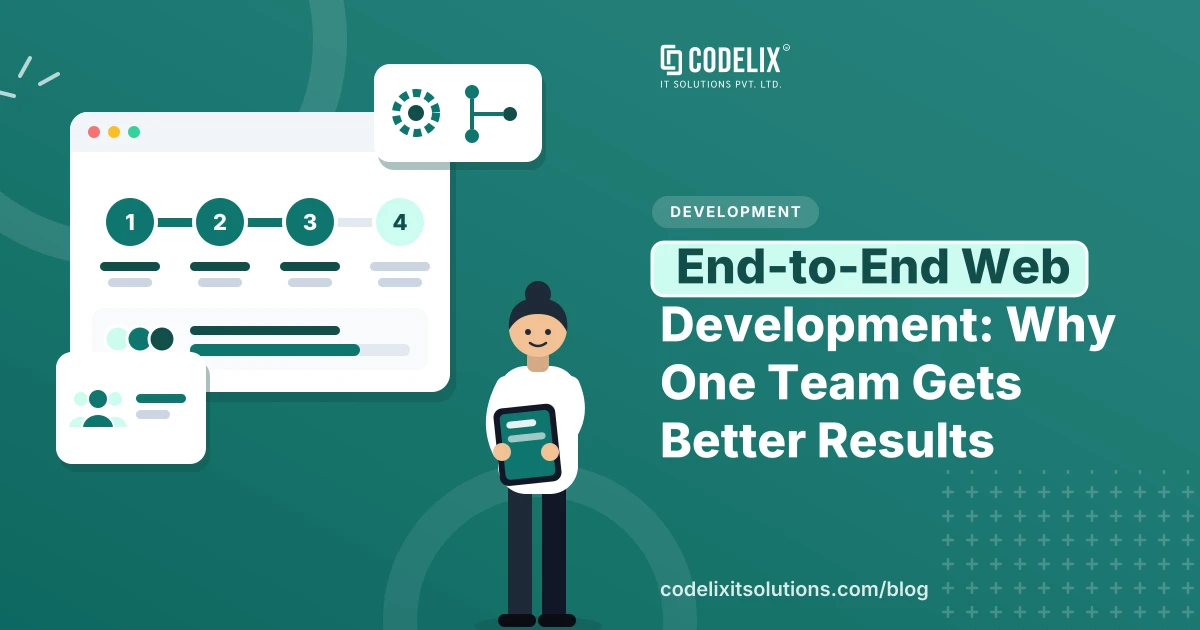
With end-to-end web development, one team owns the project from planning through design, build, launch and support, which usually means fewer gaps, fewer arguments about whose fault something is, and a product that works the way it was designed. Splitting it across a designer, a developer and a hosting company can save money on paper, but the handoffs are where projects slip.
Most people who come to us with a stalled project describe the same thing. The designer delivered screens that looked good but couldn't be built as drawn. The developer built something close to them. Nobody planned hosting or backups, and when the site broke, everyone pointed at someone else.
What does end-to-end web development cover?
The whole lifecycle, handled by one team:
- Ideation: understanding the goals, users and must-have features
- Planning: scope, milestones and a written quotation
- Design: wireframes and screens, reviewed with you
- Development: front end, back end, database and integrations, built in sprints
- Testing: on real devices, against your real use cases
- Deployment and support: launch, monitoring and fixes after go-live
Why does one team work better?
Design and engineering talk early
When designers and developers sit on the same team, impossible ideas get caught in the design stage instead of halfway through the build. That's cheaper and calmer for everyone.
One person is accountable
You have one point of contact. If something goes wrong after launch, there's no argument over who's responsible.
Fewer things fall through the gaps
Security, backups, performance and handover documents are easy to forget when each vendor only owns a slice. An end-to-end team owns all of it.
When is splitting vendors fine?
It can work if you have a strong in-house product manager who can coordinate everyone, or if one part is truly separate, like a brand identity designed long before the website. Without that coordinator, the gaps usually show.
Free consultation
Planning something like this?
Tell us what you need. After a short call we send a written scope, timeline and fixed quote.
What should you check before hiring?
- Ask to see projects they designed and built, not only one or the other
- Ask who handles hosting, backups and support after launch
- Ask for a written scope and a payment plan tied to milestones
- Confirm you'll own the code, the domain and the design files
- Ask how often you'll see working progress, not just status reports
What should the contract include?
A good agreement protects both sides and avoids most disputes:
- A written scope listing features, pages and integrations
- Milestones with what's delivered at each one, and the payment tied to it
- Who owns the code, designs and domain at the end (it should be you)
- A support window after launch and what it covers
- How change requests are priced and approved
- Confidentiality, with an NDA if needed
- Hosting: who sets it up, in whose account, and who pays for it
How Codelix works
We run projects end to end: ideation in 2 to 3 days, planning in 3 to 5 days, design in 1 to 2 weeks, development in 2 to 8 weeks in sprints, testing in 1 to 2 weeks, then deployment and ongoing support. Billing is a detailed quotation with milestone-based instalments. Our process page shows each stage, and our web development page covers what we build.