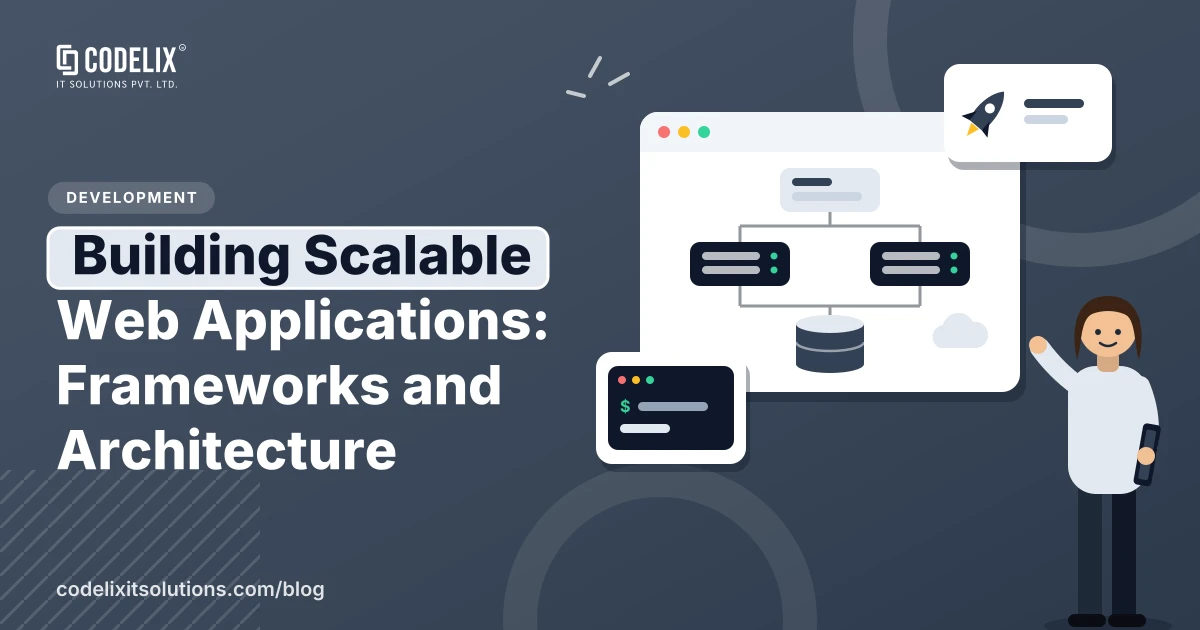
A scalable web application depends far more on architecture, database design and hosting than on which framework you pick. React, Next.js, Laravel, Node.js, Django and Spring Boot can all run large applications. For most business apps, a well-structured single application with good caching and a cloud database will scale further than you expect. Microservices are for when a team or a workload has truly outgrown that.
Founders often ask us to "build it to scale to a million users" before they have a hundred. The cost of over-engineering is real: slower delivery and higher hosting bills for traffic that hasn't arrived. The trick is to make the decisions that are hard to change later, and leave the rest simple.
What is a scalable web application?
An app scales when it keeps working well as users, data and features grow. That covers three things:
- Load: more people using it at the same time
- Data: more records, files and history
- Team: more developers working on it without tripping over each other
You scale vertically by giving a server more power, and horizontally by adding more servers behind a load balancer. Horizontal scaling is where architecture choices matter.
How do you choose frameworks?
| Layer | Common choices | Pick it when |
|---|---|---|
| Front end | React, Next.js, Vue, Angular | Next.js for SEO-heavy sites, React for app-like dashboards |
| Back end | Node.js, Laravel, Django, Spring Boot | Match the team's skills and the workload |
| Database | PostgreSQL, MySQL, MongoDB | Relational for business records, document stores for flexible data |
The best framework is usually the one your team knows well and can hire for.
Which decisions are hard to change later?
- The data model. Getting tables and relationships right early saves painful migrations.
- Multi-tenancy, if you're building SaaS. Retrofitting tenant separation is expensive.
- Authentication and permissions.
- Keeping the app stateless, so you can add servers when needed.
Get these right and most other things can evolve.
What helps an app handle more load?
- Caching frequently read data with Redis
- Moving slow work like emails, reports and imports into background queues
- Read replicas for heavy reporting
- A CDN for images and static files
- Containers (Docker) and managed cloud services so you can add capacity without manual work
Free consultation
Planning something like this?
Tell us what you need. After a short call we send a written scope, timeline and fixed quote.
When are microservices worth it?
When separate parts of the system have very different load, or separate teams need to release independently. Before that, a "modular monolith", one application with clear internal boundaries, gives most of the benefits with far less operational overhead.
What are the signs your app is struggling?
You'll usually see these before anything breaks:
- Pages that were fast now take several seconds at busy times
- Reports or exports that time out
- Database CPU running high for long stretches
- Errors appearing only under load, such as during a sale or month-end
- Developers afraid to change one part because it breaks another
Each points to a different fix: caching, queues, query tuning, more servers, or cleaning up the code structure.
Where should you host for Indian users?
Hosting close to your users keeps the app fast. Major cloud providers have Indian regions, including AWS in Mumbai and Hyderabad. If your contracts or regulations require data to stay in India, choose an Indian region from the start, because moving data later is work.
How Codelix builds for growth
We design the data model and the hard-to-change parts carefully, keep the rest simple, and set up cloud hosting that can grow with you. See our custom software development and cloud infrastructure pages.